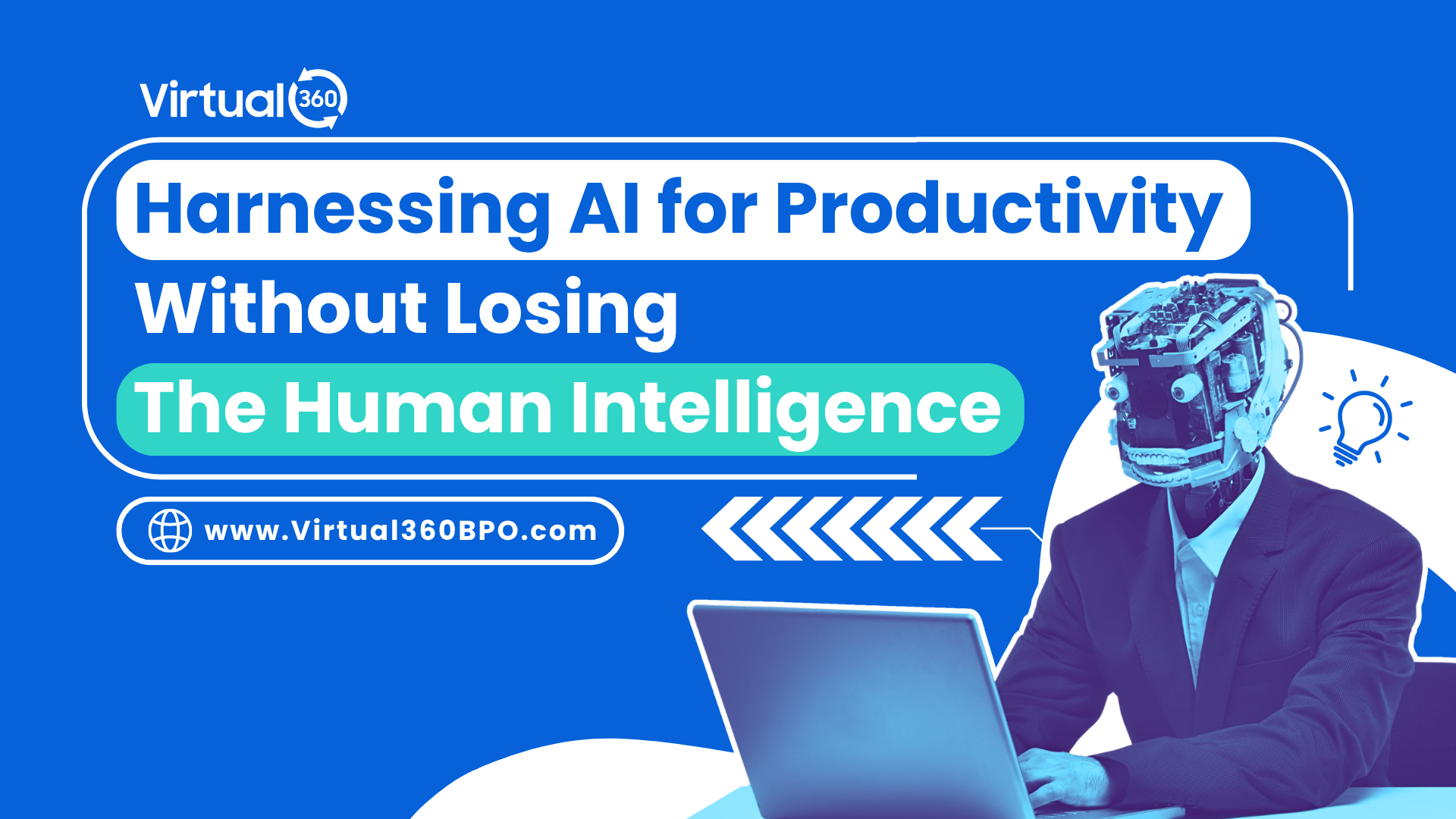
Artificial Intelligence has quickly become one of the most discussed topics in business, technology, and daily life. Some people see it as progress and opportunity, while others worry about job loss, disruption, or even losing control. The truth is simple. AI is not a replacement for human intelligence. It is a tool. A powerful tool, yes, but one that depends on human guidance, creativity, and oversight to reach its potential.
The question is not if AI will replace humans. The real question is how we decide to use it. When used wisely, AI can improve productivity, support better decisions, and free people to focus on work and ideas that require human qualities.
AI Tools to Enhance Human Capabilities
AI is strong in areas where repetition or speed matters. It can handle data entry, scheduling, and email filtering in seconds. Tasks that take hours for people are completed instantly. This allows professionals to focus on creative problem-solving, strategy, and relationships.
AI also works well as a creative partner. It can suggest outlines, generate first drafts, or highlight data trends. Humans then add expertise, vision, and context. A designer may use AI to generate layouts but still shapes the final work. A marketer may analyze customer data with AI but crafts the message with human insight. An engineer may run simulations with AI but interprets results with judgment and experience.
In all cases, the human role is central. AI is the amplifier, not the replacement.
➨ Learn how AI-powered teams combine intelligent automation with human expertise to enhance productivity, improve decision-making, and deliver stronger business results.
How AI Helps to Boost Productivity Without Sacrificing Creativity
One of the main strengths of AI is its ability to make people more productive without taking away creativity. It can help someone get started quickly, but it cannot create meaning or originality. Human imagination makes the difference.
In creative fields like writing, art, or animation, AI can draft ideas or automate repetitive steps. But the value still comes from the human vision behind the work. Culture, emotion, and lived experience shape creativity in ways that AI cannot copy. This is why human input remains vital no matter how advanced the tool becomes.
The Risk of Seeing AI as a Replacement
Concerns about AI are real. Some industries already face job shifts as repetitive roles are automated. Customer service, logistics, and some medical tasks are changing. But the larger risk is not machines taking over everything. The real risk is people stepping back and letting AI make all the choices.
If humans stop leading, control may concentrate in the hands of a few companies that own and manage the technology. This can create dependency and limit innovation. It may also reduce trust if people feel that decisions are made only by machines.
AI needs human direction. Without it, AI has no purpose. With it, AI strengthens both business performance and human potential.
Adaptation Over Replacement
History shows that every major shift in technology has raised fears of job loss. The printing press, the industrial age, and the internet all caused disruption. But each also created new opportunities and new roles. AI is the same.
Some tasks will disappear, but new jobs are already forming. Roles such as AI trainers, automation specialists, and data ethicists are becoming important. Existing professions are also being reshaped. Teachers use AI to personalize learning. Doctors use it to analyze scans faster. Entrepreneurs apply it to build lean businesses with smarter workflows.
The difference lies in adaptability. People who learn to use AI as a tool will grow. Those who resist may fall behind. The future belongs to those who evolve with technology rather than fear it.
Why Human Intelligence Still Matters
AI can process data at incredible speed, but it lacks qualities that define humans. It cannot show empathy. It does not have intuition. It does not understand ethics. These traits guide decision-making in ways machines cannot replace.
A machine may recommend an action, but a human decides whether it is right. In leadership, trust and emotional intelligence matter. In storytelling, culture and imagination matter. In healthcare, empathy and context matter.
AI cannot replicate these qualities. It may assist, but the human element remains at the core of meaningful work.
Practical Ways to Use AI Tools at Work
Using AI does not require starting from zero. Professionals and businesses can begin with simple steps:
- Automate repetitive tasks: Use AI for scheduling, reporting, or email filtering to save time.
- Boost creativity: Let AI generate ideas or outlines, then refine them with your expertise.
- Support decision-making: Apply AI analytics to spot insights, but validate them with human judgment.
- Enhance digital presence: Use AI for content suggestions or optimization but keep your authentic voice.
- Maintain oversight: Always review and fine-tune AI outputs for accuracy, ethics, and alignment with goals.
These steps help integrate AI into daily work without losing control or creativity.
The Bottom Line
AI is not here to replace humans. It is here to work with humans. The real danger is not in the technology itself but in how people choose to use it. Treated as a tool, AI raises productivity, creativity, and insight. Seen as a replacement, it risks stripping away the human qualities that give work meaning.
The future of work will not be written by machines alone. It will be shaped by people who use machines with wisdom. The smartest move today is not to fear AI but to learn to partner with it. The future belongs to those who can combine human intelligence with the speed and precision of AI.
Ready to Put AI to Work in Your Business? Our team of virtual specialists knows how to combine AI tools with expert support so you can automate smarter, improve efficiency, and focus on growth.Book a consultation with Virtual360 today
Resources:
- https://link.springer.com/article/10.1007/s11301-025-00494-9
- https://www.researchgate.net/publication/352937210_AI_Creativity_and_the_Human-AI_Co-creation_Model
- https://www.forbes.com/sites/bernardmarr/2024/11/28/ai-wont-replace-humans–heres-the-surprising-reason-why/
- https://www.library.hbs.edu/working-knowledge/how-humans-outshine-ai-in-adapting-to-change